
Why Use Camouflage?
The word camouflage comes from French and refers to the ability to disappear into your surroundings through visual deception.

Over millions of years, predators and prey alike have evolved highly specialized ways of staying hidden. These camouflage strategies are shaped by habitat, light conditions, vegetation, and the animals that either hunt or are hunted.
Camouflage in nature works in several ways. For prey animals, it is about blending into the environment to avoid detection. For predators, it is about getting close without being seen. Remaining unnoticed has always been one of nature’s most effective survival strategies — and it is just as relevant to hunters today.
Modern camouflage clothing became widespread during the Second World War, when it was used by American Marines in the Pacific. Since then, camouflage has developed into a major global industry and remains central in both military and hunting environments. The principle is simple: what can be seen can be identified, and what can be identified can be avoided or targeted.

Among hunters, there is often debate about how necessary camouflage really is. But in practice, well-designed camouflage gives a clear advantage. Used correctly, it helps keep the hunter concealed until the animal is within range.
How Camouflage Works
Camouflage has three main purposes:
- To break up the human/predator/prey animal outline and signature
- To help blend in with the surroundings
- To reduce the visibility of movement
Movement is the hardest thing to conceal. Many prey animals are extremely sensitive to even the slightest motion. This is why the effectiveness of the pattern matters so much. In nature, both predators and ambush hunters often move slowly, stay low, and merge visually with the terrain before advancing. The same principle applies to hunting.
The more naturally you become part of the background, the easier it is to close distance without creating alarm.
The Importance of Breaking the Human Outline
The most critical function of camouflage is to disrupt the unmistakable shape of a human body.
Animals do not always react to detail first — they react to recognition. If your outline is visible and familiar, the animal quickly associates it with danger. But if your form is broken up and visually absorbed into the background, recognition takes longer — and that extra time can be decisive.

Camouflage Strategies in Nature
Nature provides many examples of successful camouflage. Some of the most important principles include:
Cryptic Camouflage
This is the classic form of camouflage — patterns and colors that match the background so closely that the animal seems to disappear. 
Color Adaptation
Many species simply share the same base coloration as their environment. Green parrots in rainforest canopies and sand-colored lions on dry plains are classic examples.

Disruptive Patterning
Patterns such as stripes, blotches, and broken contrasts help blur the body’s natural outline. Tigers and leopards use this principle to great effect.

Countershading
Many animals have darker backs and lighter undersides, helping to neutralize the effect of natural light and shadow. This reduces visual depth and makes the body harder to detect.

Camouflage used in clothing today
All the above-mentioned camouflage strategies (cryptic, colour adaptation, etc.) are highly specialized and have evolved over millions of years in both prey animals and predators.
It is obvious that camouflage patterns used by hunters must be a combination of them all.
Micro pattern
Micro patterns help the hunter blend in with the surroundings at close range when remaining still, but appear more like a “grey mass” at a distance.

Macro pattern
Macro elements help the hunter blend in at long range and are extremely effective at breaking up the human silhouette, although they are less effective at close range.

Combination Patterns
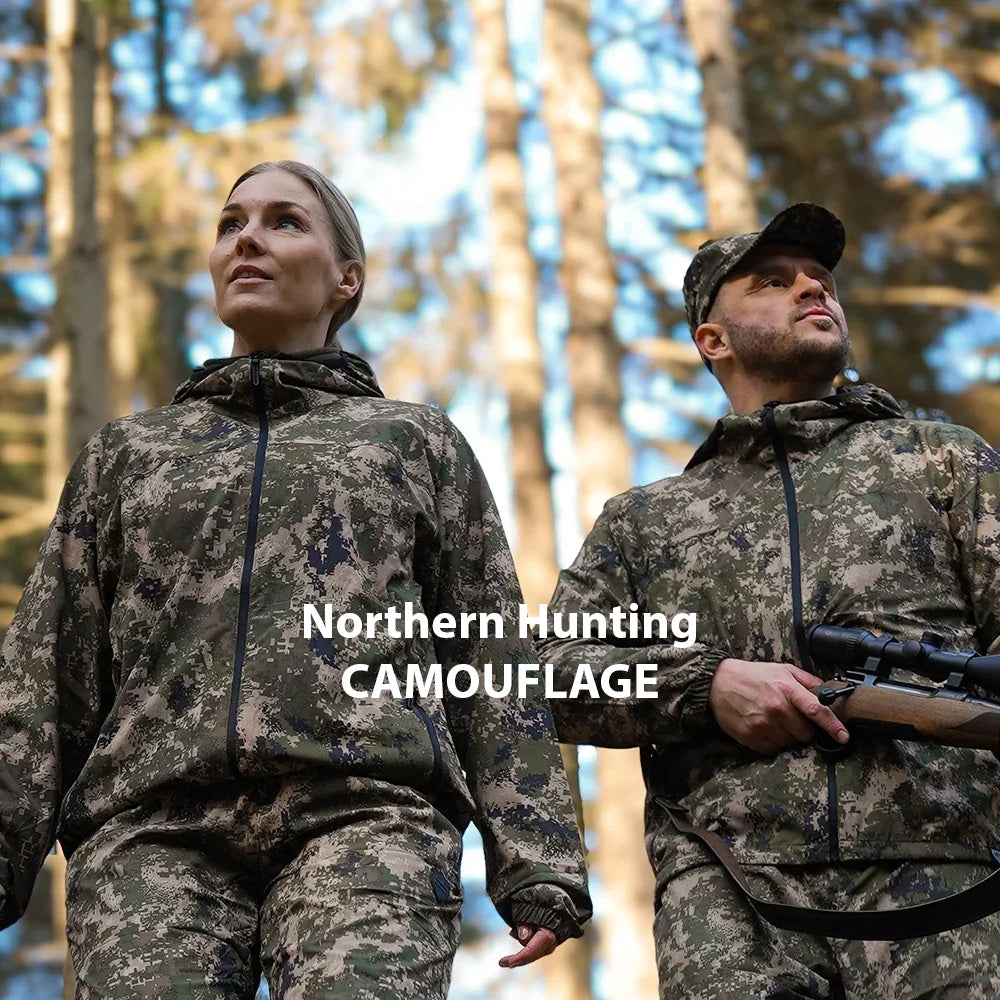
Today, the most effective hunting clothing camouflage is often based on a combination pattern — designs that merge micro patterns (details) with macro pattern (disruption) – also often called “digital camouflage”.

Northern Hunting OPT2 and OPT9 are such types of camouflage.
Both are built as combination camouflage patterns, allowing them to perform across a wider range of hunting situations than more traditional or purely imitative designs.
Where some camouflage patterns work only when the hunter remains stationary, Northern Hunting’s combination approach is designed for active hunting as well — especially stalking, where concealment during controlled movement is crucial.
Choosing the Right Camouflage for the Terrain
There is no universal camouflage pattern that works perfectly everywhere. Terrain, vegetation, light conditions, weather, and hunting style all affect how a pattern performs.
That is why choosing the right camouflage should always begin with understanding the environment.
Forest Hunting or darker surroundings: Northern Hunting OPT2
Forests are dominated by shadow, broken vertical structure, bark textures, dark soil, branches, and filtered light. In these environments, camouflage needs deeper tones and stronger contrast to work naturally under the canopy. Northern Hunting OPT2 is designed specifically for these conditions. 
Also in rocky surroundings with darker colours and contrats the Northern Hunting Opt2 works well.

Its structure supports concealment in woodland terrain by integrating with darker surroundings and fragmented backgrounds, where shadow and contrast play a major role.
For hunters moving through woodland, sitting along forest edges, or stalking through darker cover, OPT9 offers a highly relevant solution. It is especially strong where the terrain is visually busy and where breaking the human outline is essential.
FIND OPT2 PRODUCTS HERE
Men's Opt2 Camo bundle offer HERE
Ladies Opt2 Camo bundle offer HERE
--------------------------------------------------------------------
Open forest / Open terrain Hunting: Northern Hunting OPT9
Open landscapes require a completely different camouflage strategy. Here, the terrain is brighter, flatter, and often more exposed. Fields, heathland, tundra, moorland, and lightly vegetated open country create conditions where lighter tones and softer transitions perform better.
Northern Hunting OPT9 is developed for exactly these environments.

As a combination pattern for open terrain, it helps the hunter blend into lighter landscapes where shadows are fewer and visibility is greater.
For spot-and-stalk hunting in open country, for glassing positions, and for movement across exposed ground, OPT9 delivers the kind of concealment needed to reduce recognition and delay detection.
Camouflage Is Part of a Bigger Strategy
Even the best camouflage does not work alone.
To remain concealed, hunters must also manage:
- movement
- sound
- wind and scent
- background and light
- body position and pace
Still, the right pattern gives the hunter a major head start.
And when that pattern is designed specifically for the terrain, the advantage becomes even more meaningful.
That way, your camouflage works with the landscape — not against it.